
Miami County Court Records After Arrest
Miami County court records after a jail arrest begin outside the jail roster. The jail record is a custody record. It may show that a person has been booked into the Miami County Jail, but the criminal case is maintained by the court system. After a person is arrested, the case may move to an initial appearance, bond setting, complaint filing, preliminary hearing, indictment, plea, trial setting, dismissal, or sentencing. Each of those events belongs to the court record rather than the jail record.
Use Miami County jail inmate records to confirm current custody, jail contact information, and the roster path. Use Miami County jail roster mugshots for booking-photo questions because the court file is not a mugshot gallery. The court side is where filed charges, docket events, bond orders, warrants tied to a case, and dispositions are checked. A booking charge should not be treated as the final charge unless the court docket confirms it.
Miami County CourtView Search
The main online path is the county's Public Access page, which links to CourtView Case Search. The Miami County CourtView/eServices portal is used for Common Pleas and Municipal Court public case information. The portal notice says case information comes from computerized records maintained by the Miami County Clerk of Courts and is treated as public information, but users must accept the site without warranties about accuracy, reliability, or suitability.
The CourtView capture was limited by CAPTCHA and interactive content, so exact name-search fields beyond the captured controls should not be assumed. Search manually through the public access link, then call the right court if a case is missing or the charge status is unclear. Municipal Court can be reached at (937) 440-3910. Common Pleas can be reached at (937) 440-6010.
The CourtView/eServices landing page captured for Miami County shows the public case-information entry point and the interactive limits a user may see.
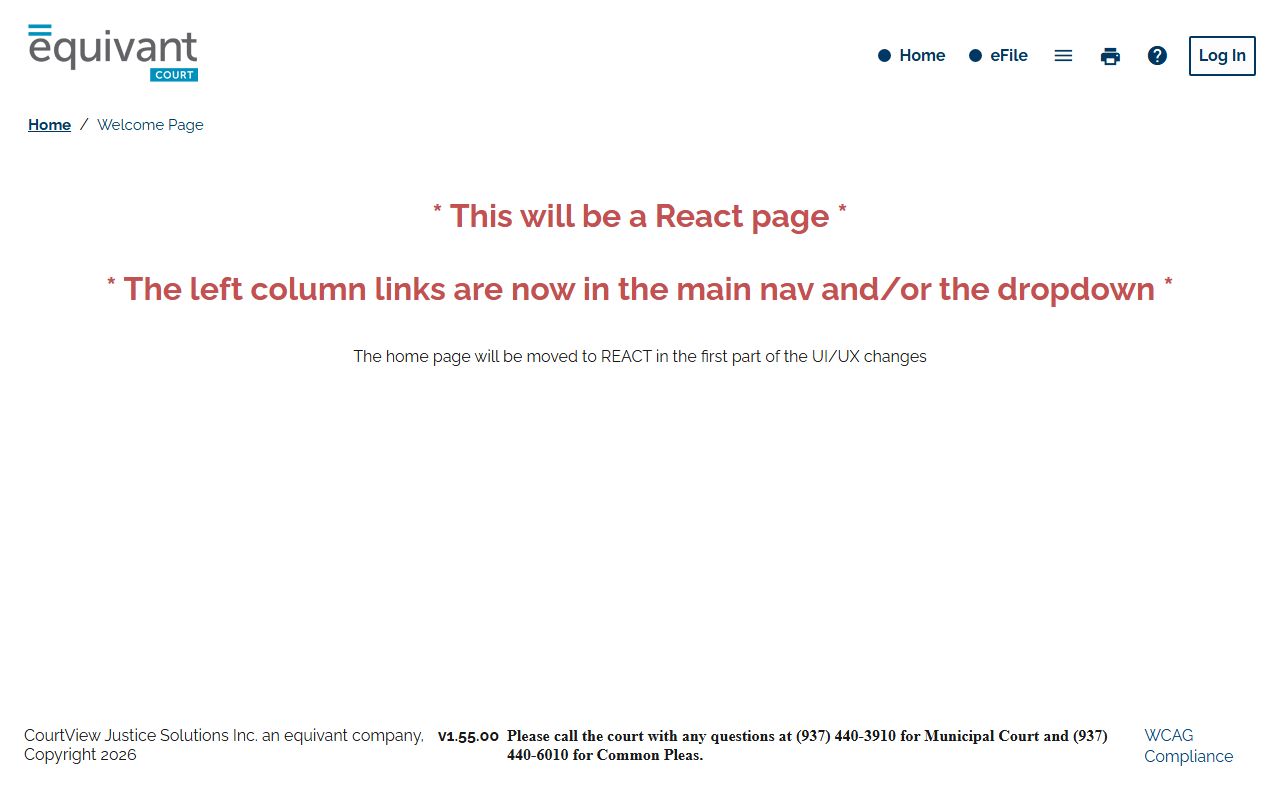
Because the portal can require human verification, court records after a jail arrest should be checked directly in a browser rather than through automated tools.
| Captured CourtView Item | Type | Required | Miami County Notes |
|---|---|---|---|
| CAPTCHA / letters from image | Text entry | Required before deeper access | The captured screen asked users to enter letters from an image. |
| eFile login | Login link | Required only for eFiling | The login is not the same as public case search access. |
| PAY button | Conditional case action | Only when available | The portal notice says a green PAY button may appear on eligible cases. |
| Court case search fields | Interactive portal fields | Not captured | Use CourtView manually. Do not assume exact fields beyond the captured controls. |
Find Court Records After Jail Arrest
A practical Miami County search starts with custody and then moves to the case. The current-custody roster can confirm whether a person is in the Miami County Jail, while CourtView is where the court charges and docket history are checked. If the arrest is recent, the jail entry may appear before the court filing. That gap does not mean no case will be filed. It may mean booking, transport, paperwork, clerk processing, or prosecutor review is still in progress.
- Check the Miami County current-custody roster first if the person may still be in jail. Note the name spelling and the jail contact number.
- Open CourtView through the county Public Access page and search with the legal name or known case number.
- Identify the court. Municipal Court handles many misdemeanor, traffic, and preliminary matters. Common Pleas handles felony cases.
- Read the charge list, docket entries, bond orders, hearing dates, and disposition lines instead of relying on the booking charge alone.
- For file-stamped copies, contact the Clerk or follow the Common Pleas public-records policy.
For Common Pleas records, the public-records policy directs inquiries to Stacy Smith, Court Administrator and Custodian of Public Records. Regular access hours are Monday through Friday, 8 AM to 4 PM, except legal holidays. File-stamped copies from court proceedings may be obtained through the Miami County Clerk of Common Pleas Court, and the published copy fees are $0.05 per single page and $0.10 per double-sided copy. The Common Pleas fax number is (937) 440-6011.
Miami County Charging Documents
Charging documents explain why court records after a jail arrest can look different from the booking record. A jail booking may start from an officer's arrest, a warrant, or a hold. The court case depends on what is filed with the court and what the prosecutor or grand jury does next. In adult felony matters, the Miami County Prosecuting Attorney prosecutes felony cases. Adult misdemeanor and traffic matters are handled by the Municipal Court Prosecutor at (937) 440-3928.
| Document | Who Files or Returns It | Where It Fits | Why It Matters |
|---|---|---|---|
| Complaint | Often an officer or prosecutor | May start a criminal case after arrest | States the initial allegation or charge basis. |
| Information | Prosecutor | Used in some felony contexts when indictment is waived or authorized | Can replace the need for a grand-jury indictment in the proper setting. |
| Indictment | Grand jury | Common Pleas felony path | Shows felony charges returned by the grand jury and filed in court. |
The prosecutor page lists Paul M. Watkins as the Miami County Prosecuting Attorney. The office is in the Safety Building, 201 West Main Street, Second Floor, Troy, OH 45373, and can be reached at (937) 440-5960 during Monday through Friday hours of 8 AM to 5 PM. The same office houses the Victim Witness Advocate Program, which is separate from public case search.
The Miami County Prosecuting Attorney page gives the felony charging office, victim-witness reference, address, and phone details used to understand the charging role after a jail arrest.
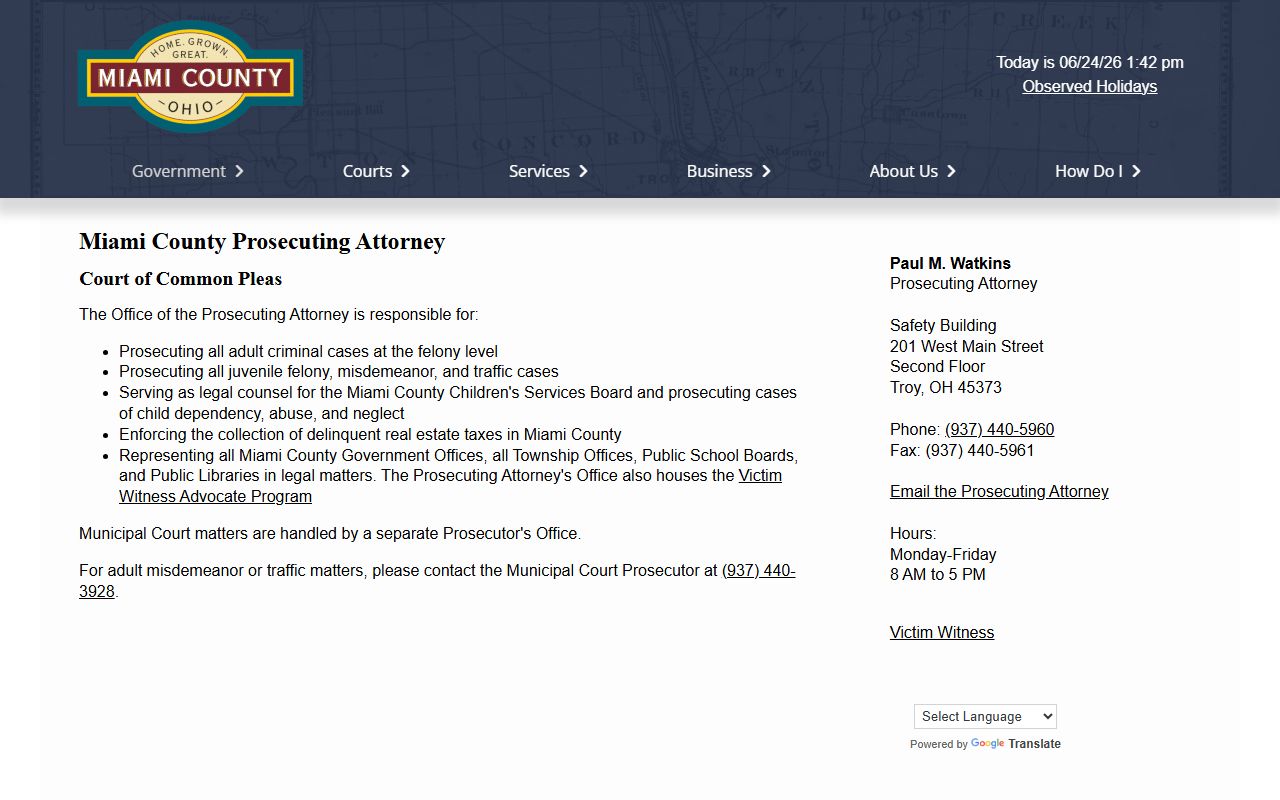
That office does not replace the court docket, but it helps explain why the filed charge can differ from the jail booking language.
Miami County Charge Status
Charge status is the current court position of each count. Miami County court records after an arrest may show several counts with different outcomes. One charge may remain pending while another is dismissed. A felony complaint may be bound over, later indicted, or amended. A misdemeanor may be reduced as part of a plea. The key is to read the status for each count and then read the docket entry that caused the change.
| Status | Plain Meaning | Record Check |
|---|---|---|
| Pending | The charge is still active and has not reached final disposition. | Check hearing dates, bond orders, and the next court event. |
| Amended or reduced | The charge language, level, or count changed after prosecutor or court action. | Compare the original filing with the later docket entry. |
| Dismissed | The court record shows the charge did not proceed in that case. | Read whether dismissal applies to one count or the whole case. |
| Bound over or indicted | The case moved toward the Common Pleas felony track. | Search for the Common Pleas case if the Municipal Court record stops. |
| Convicted | The court record shows a guilty plea, verdict, or other conviction disposition. | Review sentencing entries and any post-release or supervision terms. |
Do not collapse all statuses into one label. A person can be arrested on one accusation, charged under a different count, and convicted of a reduced offense. Court records after a jail arrest should be read as a timeline, not as a single snapshot.
Bond After Miami County Arrest
Bond is controlled by the court order and any holds, not by the public roster alone. No county-specific public bond-payment instruction page for jail release was located in the official Miami County materials. The CourtView/eServices portal states that online payment may be available for most traffic and minor misdemeanor fines when a green PAY button appears, but that is not the same as jail bond. Paying a waiverable traffic citation can also have plea consequences, so users should not treat online fine payment as a release-bond path.
Common bond terms include recognizance or personal bond, cash bond, surety bond, ten-percent or deposit bond, property bond, and no-bond hold. A detainer is a hold from another court, county, state parole authority, federal agency, or ICE. If a detainer remains, paying the Miami County bond may not produce immediate release. Confirm the controlling court, the bond type, payment location, hours, accepted payment methods, receipt process, and all holds before sending money.
Note: Call the jail, Municipal Court, Common Pleas Court, or Clerk before relying on any third party for bond payment instructions.
Miami County Warrant Records
No official Miami County Sheriff active-warrant search page was found in the official county materials. That gap matters. Warrant checks should use court, clerk, sheriff, prosecutor, or law-enforcement contact paths rather than commercial warrant aggregators. A warrant tied to a criminal case may appear in CourtView as a docket event, capias or bench warrant entry, failure-to-appear event, bond forfeiture, or warrant return, but the exact searchable fields were not captured because the court portal required interactive access.
For routing, the Sheriff's Office administration and records number is (937) 440-6085, and the communications center is (937) 440-9911. For current custody after a warrant arrest, the inmate information line is (937) 440-3961 and downtown jail control is (937) 440-3971. Municipal Court can help with municipal matters at (937) 440-3910, and Common Pleas can help with felony court records at (937) 440-6010.
An arrest warrant authorizes custody based on a complaint, indictment, probation violation, or similar legal basis. A bench warrant or capias is often issued by a judge for failure to appear or failure to comply with a court order. A search warrant is different because it authorizes a search, not a custody record for a person.
Charges vs Convictions
A charge is an accusation in the court record. A conviction is a final result based on a plea, verdict, or other legally recognized disposition. Miami County court records after a jail arrest may show both, but they should not be described as the same thing. A jail roster charge, complaint, or indictment does not prove guilt. The docket must show the disposition before the record can be described as a conviction.
| Point of Comparison | Charge | Conviction |
|---|---|---|
| Stage | An allegation filed or pending in court. | A resolved outcome based on plea, verdict, or qualifying finding. |
| Where to verify | Complaint, information, indictment, docket entry, or charge list. | Judgment entry, plea entry, sentencing entry, or disposition line. |
| Can it change? | Yes. Charges may be amended, reduced, added, bound over, or dismissed. | Later action is possible, but the record should show the final order. |
| How to state it | Use "charged with" unless the case disposition says more. | Use "convicted of" only when the court record supports it. |
Ohio Court Records Access
Ohio public access starts with ORC 149.43, the Ohio Public Records Act. It gives access rights to records kept by public offices unless a specific exemption applies. For jail records, ORC Chapter 341 governs county jails and includes the jail-register duty. The jail register records each prisoner's name, date and cause of commitment, and date and manner of discharge. Those jail-register facts can help connect a custody event to a later court case.
Common Pleas public-records requests use the court's local policy. The policy says records are available within a reasonable time during regular county business hours, Monday through Friday, 8 AM to 4 PM, except legal holidays. It also identifies Stacy Smith as custodian for public-record inquiries and lists copy costs of $0.05 for a single page and $0.10 for a double-sided copy. The Common Pleas public-records office is listed at the Safety Building, 201 W. Main St., Third Floor, Troy, OH 45373. File-stamped copies from proceedings are obtained through the Miami County Clerk of Common Pleas Court.
The Miami County Public Access page is the county gateway for CourtView Case Search and Probate Case Search.
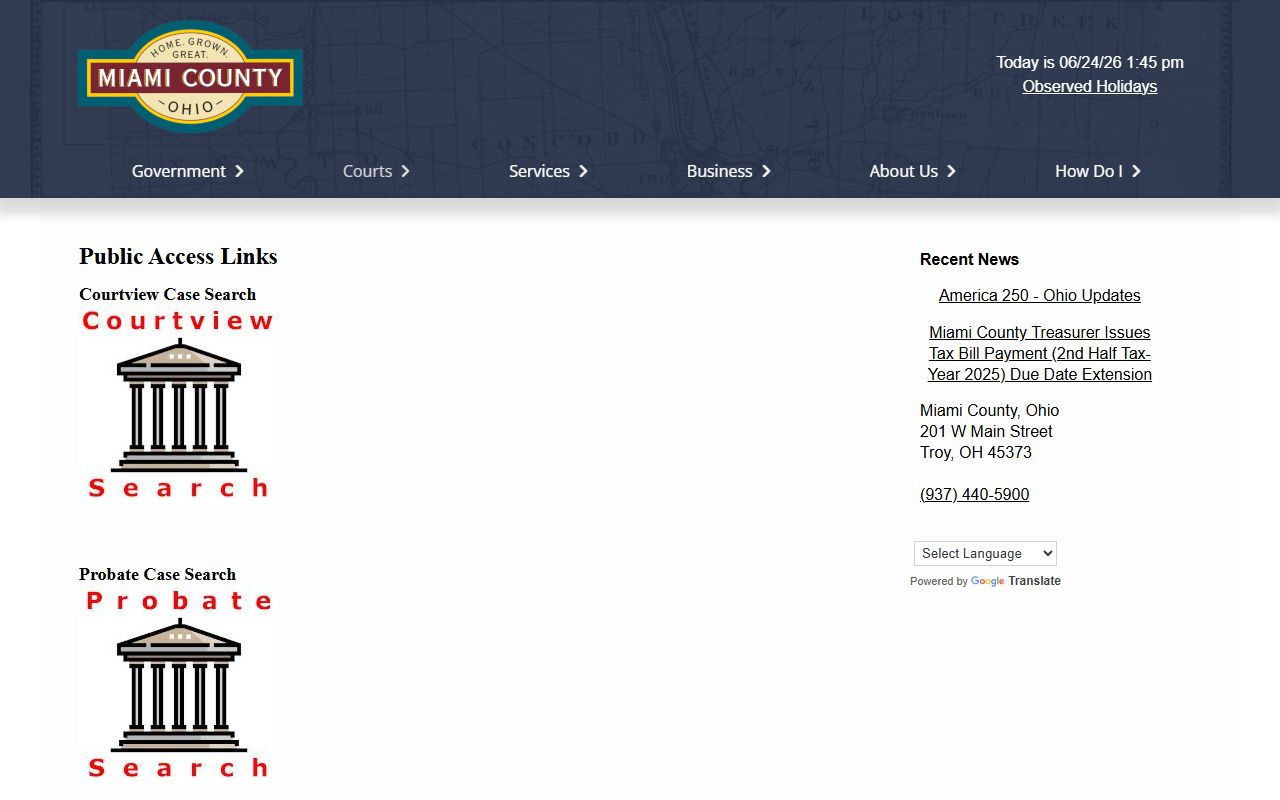
Use that public access route for the online search, then use the clerk or court public-records process when certified or file-stamped copies are needed.
Sealed vs Expunged Records
Sealing and expungement are court-controlled record-clearing paths, not jail-roster edits. Ohio law addresses eligible criminal records through ORC 2953.32 and the effect and notice of sealing or expungement orders through ORC 2953.34. Eligibility depends on the case, the disposition, timing, prior record, and statutory limits. Court staff can describe procedures, but legal eligibility questions may require counsel.
| Point of Comparison | Sealed | Expunged |
|---|---|---|
| Basic effect | Public access is restricted by court order. | Records are destroyed, deleted, or treated under Ohio law as expunged where allowed. |
| How it happens | A court grants an eligible sealing request. | A court grants expungement under the statute when the record qualifies. |
| Agency notice | The court sends notice to affected agencies. | The court sends notice to affected agencies under the expungement order. |
| Commercial sites | The order affects official record access, not every repost online. | The order still does not guarantee removal from third-party search results. |
A dismissed charge is not automatically sealed. A release from jail is not an expungement. If a Miami County court record after an arrest is eligible, the clearing path runs through the court that has authority over the case and the applicable Ohio statute.
Restricted Miami County Records
Some court or jail-related records may be limited even when many records are public. Juvenile custody and juvenile court records are handled differently from adult Miami County jail records. The West Central Juvenile Detention Center serves Miami County youth and other counties, but juvenile records are not searched like the adult jail roster. Sealed cases, expunged records, certain victim information, some investigatory material, and records affected by a court order may also be withheld or redacted.
Background checks are a separate issue. Public court or jail information is not a consumer report under the Fair Credit Reporting Act, and it may not be used for credit, employment, tenant screening, insurance, or any other FCRA-regulated purpose. For a formal screening decision, use a compliant background-check provider and verify records at the source.
Important: Court records after an arrest may be incomplete online. Verify urgent charge, bond, warrant, or hearing details with the originating court or clerk.